What's the difference between wedge wire and perforated plate?
When selecting a screening or filtration media for industrial processes, two of the most common options are wedge wire screens and perforated plates. Both serve the fundamental purpose of separating solids from liquids or classifying particles by size. Yet their design, performance, and longevity differ significantly. At JX Filtration, we manufacture both types, but our engineering expertise often leads clients toward wedge wire solutions for demanding applications—especially when customized to their exact process conditions.
Similarities – What They Share
Both wedge wire screens and perforated plates are made from metal materials—typically stainless steel, carbon steel, or alloys—and are used across industries such as mining, water treatment, food processing, and chemicals. They can be fabricated into flat panels, curved sections, or cylindrical elements, and both allow for some degree of customization in terms of dimensions and material grades. In their simplest forms, they provide a barrier that retains oversize solids while allowing liquids or fine particles to pass.
Key Differences – Where They Diverge
Manufacturing Process:
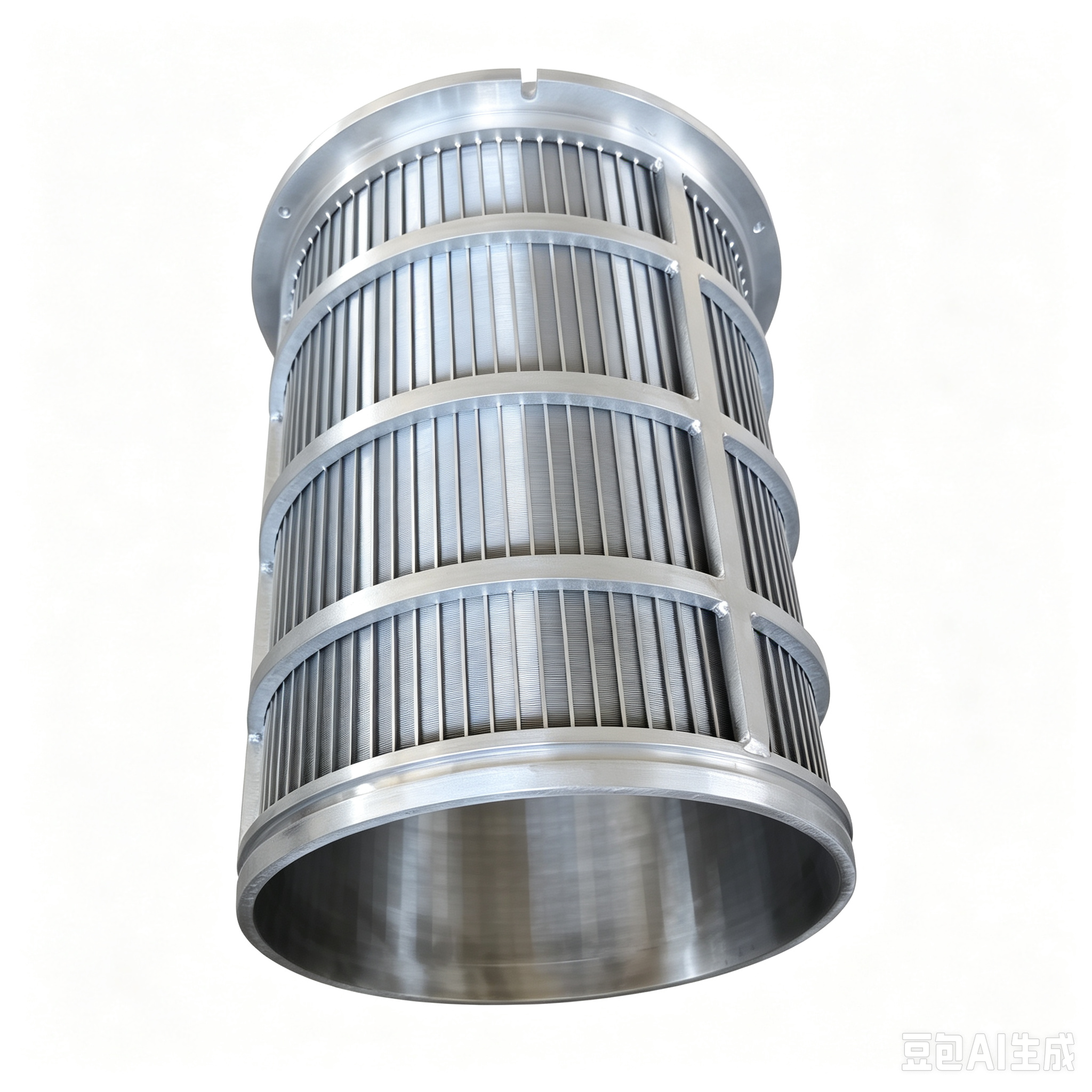
Perforated plates are produced by mechanically punching or stamping holes—round, square, or slotted—into a solid sheet of metal. This process weakens the sheet around each hole and limits the pattern density. Wedge wire screens, in contrast, are constructed by resistance‑welding V‑shaped profile wires onto parallel support rods. This creates continuous, precisely controlled slots without any material removal.
Slot Geometry:
This is the most critical difference. Perforated plates have straight‑through holes with parallel walls. Particles that are slightly larger than the hole can become wedged inside, leading to blinding. Wedge wire screens feature slots that are narrowest at the surface and gradually widen inward. This V‑shape allows particles to either remain on top or pass completely through—they never get trapped mid‑slot. The result is a self‑cleaning action that dramatically reduces clogging.
Open Area and Flow Capacity:
Wedge wire screens offer open areas ranging from 15% to 65% , depending on slot size and wire profile. Perforated plates typically have lower open areas because hole spacing must leave sufficient material between apertures to maintain structural strength. Higher open area means greater throughput and lower pressure drop for wedge wire designs.
Mechanical Strength:
The welded construction of wedge wire screens creates a rigid, monolithic structure where each wire is fused to the support rods. This distributes loads evenly and resists deformation under high pressure or heavy impact. Perforated plates, with their interrupted metal matrix, are more prone to bending, tearing, or hole elongation, especially in abrasive applications.
Service Life:
In abrasive or corrosive environments, wedge wire screens consistently outlast perforated plates. With proper material selection, wedge wire can deliver 8 to 25+ years of trouble‑free service, whereas perforated plates may need replacement within months or a few years, depending on wear.
We understand that every application has unique demands. That is why JX Filtration offers complete customization for both wedge wire and perforated plate products—but we particularly excel in wedge wire engineering. We tailor slot size, wire profile, shape, dimensions, and materials (including stainless steels, Duplex, Hastelloy, and Monel) to match your feed characteristics, equipment interfaces, and performance targets. Our team can also advise on which type best suits your process, based on decades of experience across industries.


Any requirements, contact us now!
Nina
Email: nina@filtrationchina.com
Mobile/Whatsapp/WeChat:+86 172 6957 1060